To add your startup to Wikidata, create a free Wikimedia account, confirm no item for your company already exists, click "Create a new item," give it a label and a one-line neutral description, then add structural properties like instance of (P31) and official website (P856), each backed by an independent source. That is the short version. The reason to do it is bigger than SEO.
Every AEO guide now tells founders the same thing: establish your entity on Wikidata. Almost none show you how, which properties matter, or how to stop the entry getting deleted. This is that missing tutorial, written AI-first so the page you land on is the answer, not another vague nudge.
Here are the stakes in one number. In February 2026, OpenAI reported ChatGPT had passed 900 million weekly active users, more than double a year earlier (OpenAI, reported by Reuters). When those users ask an assistant "who builds X," the model replies with entities it recognises. If your startup is not a recognised entity, you are not in the answer.
Why Wikidata matters for SEO and AI visibility
Wikidata is a free, machine-readable knowledge base run by the Wikimedia Foundation, the nonprofit behind Wikipedia. The distinction is the whole point: Wikipedia stores articles for humans, Wikidata stores structured facts for machines. Every entity, whether a person, company, or product, gets a permanent identifier that starts with Q, called a Q-ID.
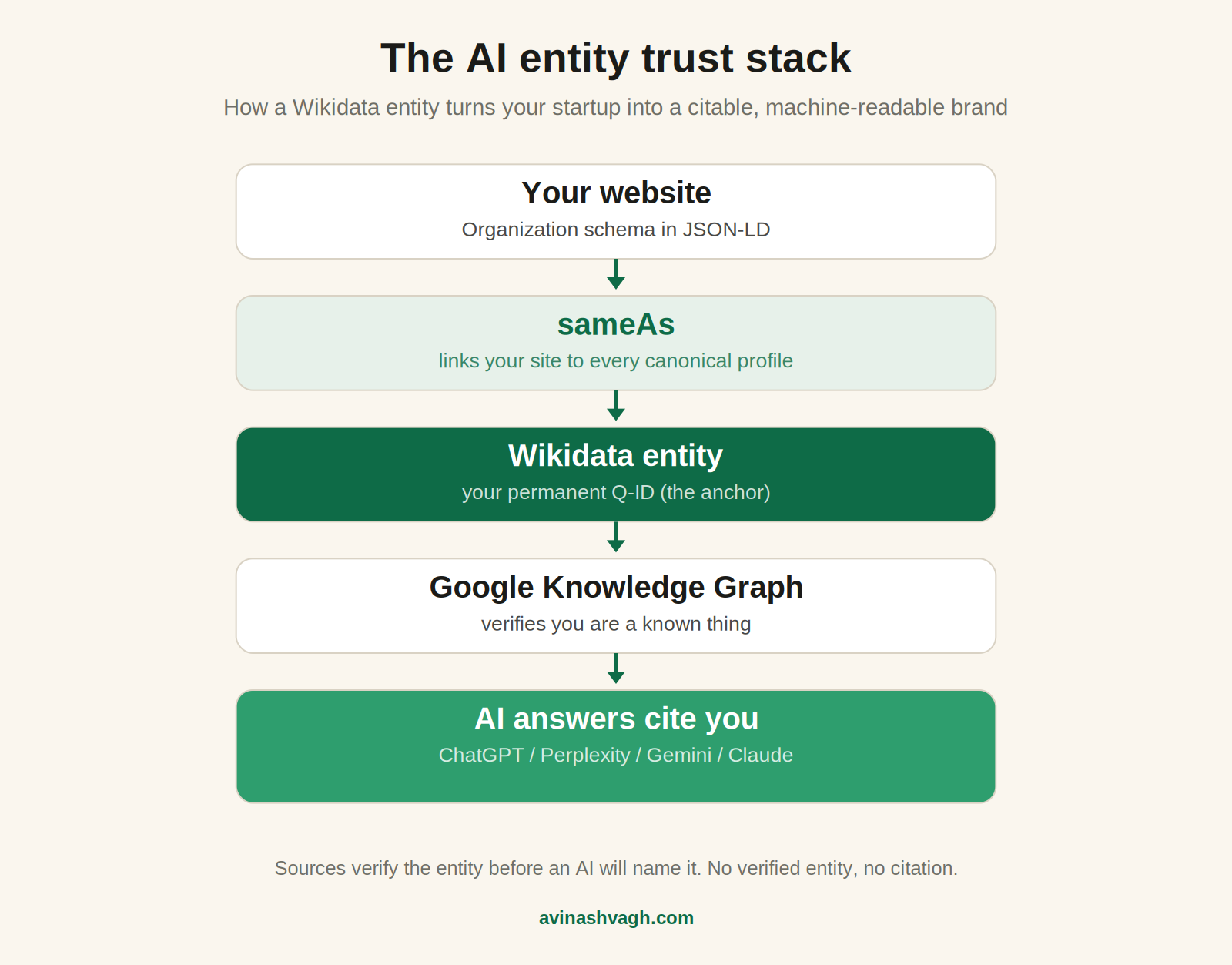
That Q-ID is why Wikidata for SEO is not a fad. Google's Knowledge Graph pulls from Wikidata to decide whether your brand is a known thing or just unknown text on a page. The same structured data feeds the models behind ChatGPT, Perplexity, Gemini, and Claude. A clean Wikidata entity for your brand is the closest thing to a passport in the knowledge graph for startups trying to get recognised.
Ranking on Google is no longer the same as being recommended by AI. Ahrefs analysed 15,000 prompts and found only about 12% of the links cited by ChatGPT, Gemini, and Copilot also ranked in Google's top 10 (Ahrefs, 2025). Being a verified entity is often what tips a model toward naming you, and that is a lever a young startup can actually pull.
Does your startup need to be notable?
This is the question that stops most founders, so answer it first. Wikidata notability is not Wikipedia notability, and it is far more forgiving.
Wikidata's own policy (WD:N) allows an item if it meets any one of three tests. The one that matters for you: it refers to a clearly identifiable entity that can be described using serious, publicly available references. In plain terms, you do not need a Wikipedia article. You need to be a real, distinct company that independent sources have written about.
What counts as a serious source: press coverage, an official business register entry, a funding announcement, an accelerator cohort page, an industry publication. What does not count on its own: your own website, your LinkedIn, or marketing copy. If a stranger could verify your startup exists and does what it claims from third-party sources, you clear the bar.
This is exactly why the entity work pairs with real PR and directory presence. If your startup has never been covered anywhere independent, fix that before creating the item, or it will be flagged and removed.
How to add your startup to Wikidata step by step
Here is the walkthrough. It takes about 30 minutes the first time.
- Search first. Go to wikidata.org and type your company name. Creating a duplicate when an item already exists is the single most common reason entries get deleted. If one exists, improve it instead of making a second.
- Create the item. In the left menu, click "Create a new item."
- Add a label and description. The label is your exact company name. The description is one neutral sentence, for example "B2B SaaS company" or "Australian fintech startup." Keep it factual. Promotional tone is a fast track to reversion.
- Add aliases. Include common variations of your name so the entity resolves however people type it.
- Add the core properties. This is where a thin item becomes a real one.
Add three or four structural properties at creation, not just a name. These are the ones that carry weight for both search engines and LLMs.
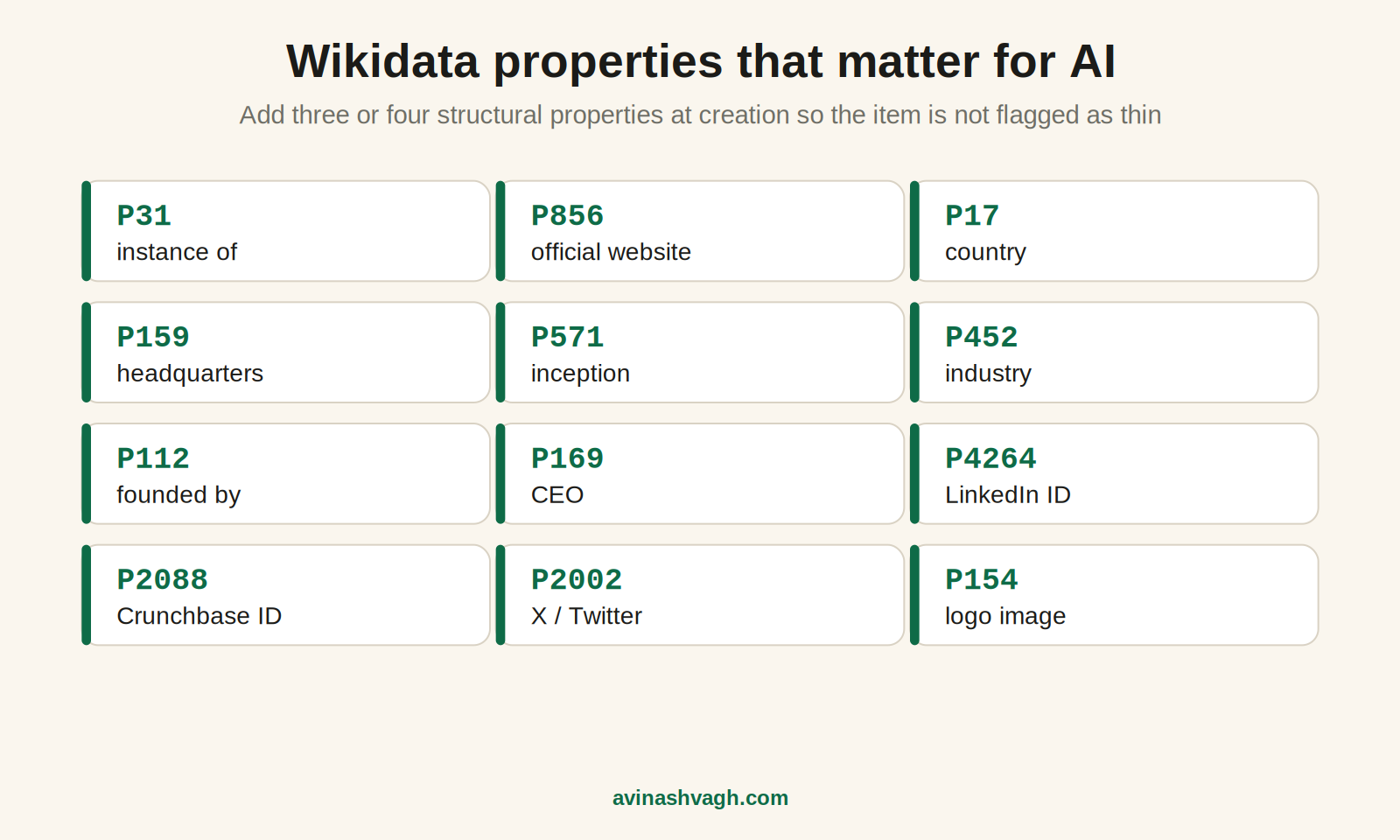
At minimum, set instance of (P31) to business, then add official website (P856), country (P17), headquarters location (P159), inception (P571), and industry (P452). Layer in the cross-platform identifiers that help models connect the dots: LinkedIn (P4264), Crunchbase (P2088), and X/Twitter (P2002). Add founder (P112) and CEO (P169) as Person entities where you can, since founder and author entities feed the E-E-A-T signals AI systems increasingly weigh.
- Reference everything. Wikidata runs on verifiability, not truth. Every meaningful statement should carry a source. An inception date backed by a press article survives. An unsourced claim gets challenged.
- Note your Q-ID. Once saved, your item has a permanent Q number. Copy it. You need it for the next step.
Wire it back to your site with sameAs schema
Creating the entity is half the job. The other half is telling search engines and AI crawlers that the entity is you. That connection is the sameAs schema property.
Inside your Organization schema in JSON-LD, the sameAs array lists every canonical profile that represents your brand. Add your Wikidata entry, LinkedIn, Crunchbase, and any Wikipedia page. This sameAs Wikidata link is the most underused high-leverage move in entity SEO. It anchors your domain to the canonical knowledge base behind Google, ChatGPT, Claude, and Perplexity, and the benefit compounds across every future AI system that uses Wikidata as a grounding source.
Keep the schema in the head of your HTML, validate it with Google's Rich Results Test and the Schema.org validator, and make sure the entity described there matches your Wikidata entity for brand exactly, down to the name. A conflicting name or description splits you into two entities the models cannot merge, which is worse than having none.
Earn a Wikipedia citation with the dead-link method
A Wikidata entity gets you recognised. A citation from Wikipedia itself strengthens that entity further, because it is one of the most trusted sources both Google and LLMs verify against. There is a legitimate, well-known way to earn one: reclaiming dead links.
Wikipedia is full of citations pointing to resources that no longer exist, and it even maintains categories of them. Simple English Wikipedia alone flags more than 13,000 articles with dead external links, and the full English version holds far more. Each dead link is a gap you can fill, if you have a genuinely better replacement.
Here is the method, applied carefully.
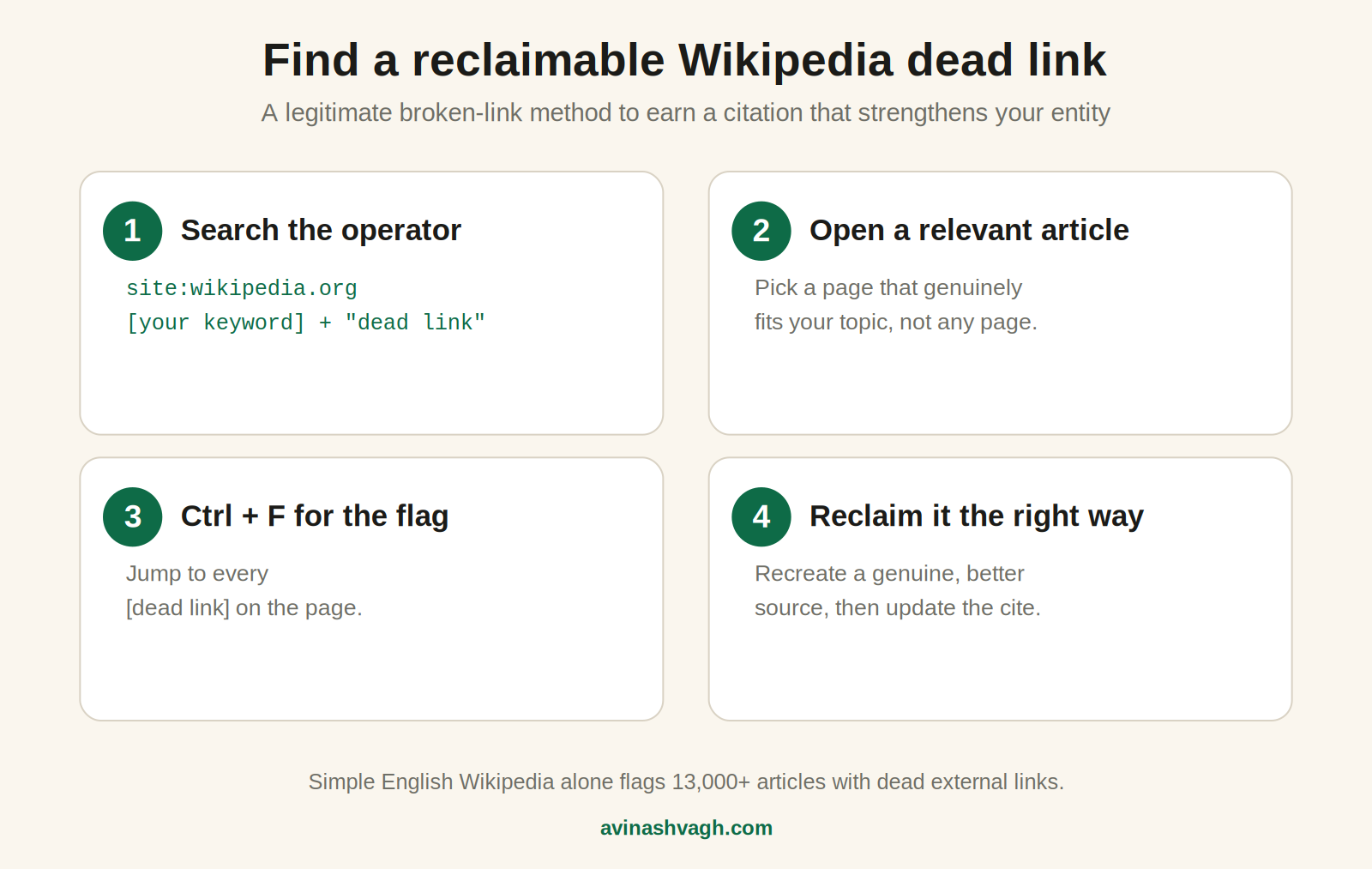
Start with a search operator that surfaces dead links in your niche:
site:wikipedia.org [your keyword] + "dead link"
Swap in your topic. An investment platform would search site:wikipedia.org investing + "dead link". Open an article from the results that genuinely fits your subject, press Ctrl+F, and search for "dead link" to jump straight to the flagged citation. You land on a reference whose original source has gone offline.
Now the part that protects your reputation. The reclamation works only if you replace the dead source with a genuine, reliable, like-for-like resource, ideally one you published because it is actually useful. Editors watch these pages. A self-serving swap to a weak page gets reverted within days, and repeat offenders get flagged for conflict of interest. Disclose your connection on the talk page, follow Wikipedia's sourcing rules, and never edit-war. Done honestly, you have improved Wikipedia and earned a durable citation. Done as spam, you have wasted an afternoon.
That is the through-line of this entire discipline: legitimate contribution survives, manipulation gets reverted.
Why Wikidata entries get deleted, and how to avoid it
Most failed entries fail for the same handful of reasons. Avoid these and your item sticks.
- Duplicates. Always search before creating. A second item for an existing company is deleted on sight.
- Thin items. A name and description with no structural properties reads as spam. Add instance of, country, and inception at creation.
- Promotional tone. Descriptions must be neutral. "Leading, innovative, world-class" gets you reverted.
- Conflict of interest handled badly. You may create an item for your own company, but disclose it, and do not delete accurate statements that carry strong sources just because they are unflattering. Wikidata values verifiability over your preferred narrative.
- Single-purpose accounts. An account that only ever edits its own brand gets less benefit of the doubt. Make a few genuine, unrelated contributions first to build standing.
The takeaway for founders
The models your buyers now ask cannot recommend a brand they cannot verify. Adding your startup to Wikidata gives you the entity node, the sameAs wiring connects it to your site, and a legitimately earned Wikipedia citation reinforces it. None of it requires authority you have not built yet, which is why entity work is the highest-leverage move a small startup can make in AI search.
Do it in the right order, source every claim, and keep the tone neutral. You become a recognised entity that ChatGPT, Perplexity, and Google's AI answers can actually name. That recognition is the foundation the rest of your AEO work at avinashvagh.com/aeo sits on.
Run a free entity audit
Want to know whether AI systems already recognise your startup as an entity? Run a free AEO audit to see exactly where your Wikidata, schema, and citations are missing.
FAQs
Can I add my own startup to Wikidata?+–
Yes. You are allowed to create an item for your own company. Disclose your connection on the talk page, keep the description neutral, and source your statements. Do not delete accurate, well-referenced facts you dislike.
Does my company need to be notable to be on Wikidata?+–
It needs to be a clearly identifiable entity described by serious, publicly available sources. That is a far lower bar than Wikipedia. You do not need a Wikipedia article, but you do need independent coverage.
Which Wikidata properties matter most for AI?+–
Start with instance of (P31), official website (P856), country (P17), headquarters (P159), inception (P571), and industry (P452), then add LinkedIn (P4264) and Crunchbase (P2088) so models can connect your profiles into one entity.
How do I connect Wikidata to my website?+–
Add your Wikidata Q-ID to the sameAs array in your Organization schema (JSON-LD), alongside LinkedIn and Crunchbase. Validate the schema and keep the entity name identical across both.
Why did my Wikidata entry get deleted?+–
Usually a duplicate, a thin item with no properties, promotional wording, or a single-purpose account. Add structural properties and independent sources, keep the tone neutral, and the item will hold.